 AgoraVox Italia
Start a WordPress blog or create a free website in seconds. Choose from over 200 free, customizable themes. Free support from awesome humans.
http://www.imhoffpress.worpress.com
Articoli
-
How to Build an Endless Stream of Content Ideas with WordPress and Claude
20 aprile, di WordPress.com Staff
The best content ideas are already in your website data.
Connect your WordPress.com site to Claude to uncover what your audience is searching for—but you haven’t covered yet—and turn those insights into published posts.
In this guide, I’ll show you how to extract those insights, turn them into a clear plan, and generate ready-to-publish content.
Step 1: Connect Claude to your WordPress.com website
Start by connecting your Claude account with your WordPress website. This is possible thanks to the Model Context Protocol (MCP) that creates a direct link between both platforms. It’s completely secure, optional to use, and available to every paid WordPress.com user.
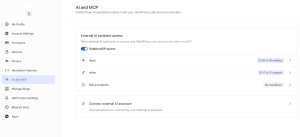
To enable MCP, head to your WordPress.com account → AI and MCP → Enable MCP Tool Access and toggle it on.
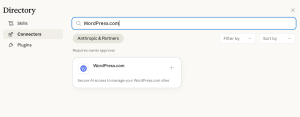
Next, head to your Claude account to enable our official Claude Code connector. Go to Settings → Connectors → Browse Connectors. In the search bar, type “WordPress.com,” and select the + button to initiate a connection with your website.
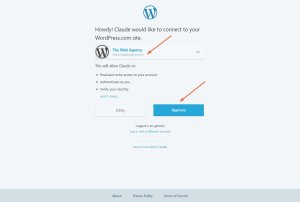
Finally, approve Claude’s access to your website. Select the right website before clicking the Approve button.
Step 2: Ask Claude to review your website and find content gaps
Next, ask Claude to scan the website’s existing content and identify missing topics. You can use a prompt similar to the one below and adjust it based on your own context and needs:
“I founded a web agency that offers website development and maintenance services. My WordPress agency specializes in building marketplace websites, job boards, membership sites, and WooCommerce stores. I want my site’s blog (https://acustomdomain.com/blog) to be the go-to resource for prospects and clients. I need you to review my site and find content gaps/topics that I can write articles on.
1. Find content gaps from existing blog posts
Review my existing posts and identify any unanswered questions on web development and maintenance. Also, analyze user comments to spot recurring questions and interests. And look for traffic insights to understand audience interest. List 20 important missing topics that would interest my visitors.
2. Identify content gaps from competitors
Review existing blog posts on the following competitor websites: https://example.com/blog/, https://example.com/blog/, and https://example.com/blog/. List 20 key topics that aren’t covered on my website.
3. Find and suggest improvements for weak blog posts
Identify posts that appear incomplete or lack useful information. Then, recommend any additional sections or details that could improve the blog posts.
Note: Keep your answers short and easy to navigate.”I tried this approach for my own website, and Claude instantly came up with a range of relevant content ideas like “How to build a marketplace website on WordPress” and “How to choose between a membership site and a subscription site.”
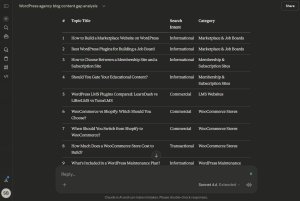
Claude also generated recommendations for how to improve existing blog posts on my site. It highlighted articles that were missing key elements like examples and data references, and explained how to add the necessary fixes.
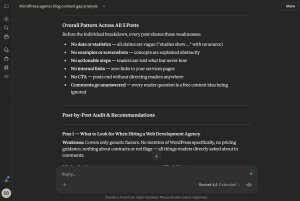
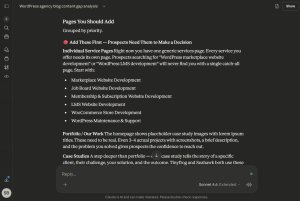
From here, I tested it for other formats such as service pages and FAQs. This workflow is effective for any query related to your site, such as tips on key pages, pricing, case studies, or something else.
Step 3: Ask Claude to prioritize topics and create a content calendar
Next, instruct Claude to rank topics based on their potential impact on your business and website. This helps you prioritize your efforts and put together a plan that will genuinely help you get relevant visitors and leads.
I used the following prompt to ask Claude to rank my content topics:
“Prioritize the content topics you suggested earlier based on my goals, which are to:
– Write articles to answer questions that prospects have when evaluating web development services, and
– Write articles that help existing clients get the most out of our services.
I’m trying to decide which articles to write first and how to allocate my resources.”Claude returned a table, ranking each topic by the value it delivers to prospects and clients:
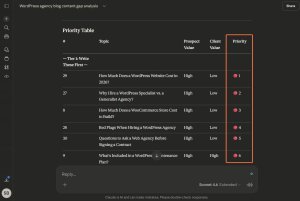
I noticed that Claude weighed topics that targeted prospects higher than those targeting clients. It assumed my blog’s main job is to bring in new business, because that’s the first goal I shared in the prompt.
So, I asked Claude for a different approach, and it devised a combined scoring system that weighted both goals equally. The output was better this time:
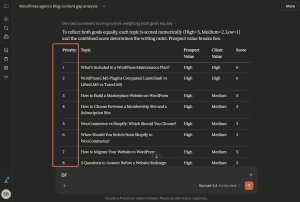
From here, ask Claude to build a fully operational roadmap for your content. This document will serve as your content calendar, which is essential for planning and effective execution. Here’s the prompt I used:
“With the topics prioritized, the next step is to map them to a content calendar. The calendar will give me a clear view of upcoming content activities and keep me accountable.
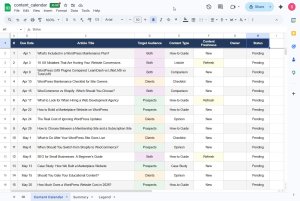
Consider adding these in the calendar: Timeframe, publication frequency, calendar columns — due date, article title, target audience, content type, content freshness, owner, status, balance prospect-focused and client-focused content, content mix — add different content types like articles, case studies, listicles, comparisons, and add existing blog posts as they need to be updated/refreshed.”Here’s what it came up with:
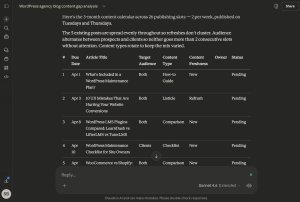
Finally, I asked Claude to convert the calendar into an Excel sheet. It returned two options: download directly or open it on Google Sheets. It’ll need your Google Drive access for the second option.
Step 4: Create Claude-assisted outlines and articles
Now, select one of the priority topics, ask Claude to generate an outline, and proceed to create the article.
First, feed Claude all the necessary context (like the article title, goal, and target audience), and it will return a solid outline. Here’s the prompt I used:
“I need help creating an outline for an article.
Topic: WordPress LMS Plugins ComparedArticle goal: Help readers compare WordPress LMS plugins and choose the right one for their business.
Start by reviewing competitor articles covering the same topic. Then, create an outline for the article containing: an introduction, a TL;DR with a table comparing the tools against various criteria, main sections (H2 headings), supporting subsections (H3 headings), and final thoughts.
Provide instructions on how to naturally highlight relevant services, products, or features of the agency if possible.”Instantly, I received an outline showing how to cover the introduction and conclusion and what information to include in each subsection of the article.
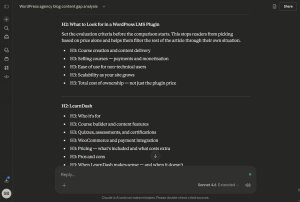
Review the outline carefully and ask Claude to adjust anything before moving forward, such as reordering sections and trying out different subheadings.
From here, you can use the outline as a starting point and draft the article based on your knowledge and expertise.
Step 5: Ask Claude to add the article to WordPress.com
Once your article is ready, upload it as a PDF or markdown file to Claude, and tell Claude to add it to your WordPress website as a post.
This is the prompt I used to instruct Claude:
“Save this article as a draft on my WordPress website. Add a category and include appropriate tags, write a meta description, suggest where I can link other existing posts and pages throughout the content, and add images from the media library.” Claude seeks additional confirmation before adding the article to the website. Once you confirm, it creates the post, defines categories and tags, and adds the article to your site.
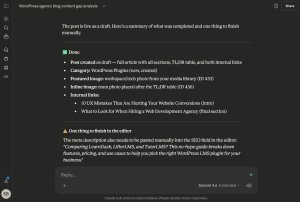
Claude also flags any tasks left undone, like adding the meta description manually.
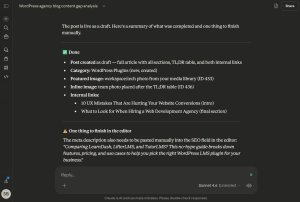
Open the article on your website and check the categories, tags, images, and interlinks.
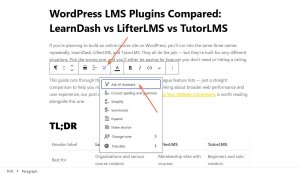
If you need to carry out quick edits to the text (like correcting grammatical mistakes and plugging logical holes), use WordPress’s native AI assistant.
Head to your WordPress account → Sites → Settings → AI tools → Enable AI assistant and toggle it on if you’re on a Business or Commerce plan (or if you built your site with our AI website builder).
Then, select the Sparkle option from the toolbar and click “Ask AI Assistant” to add a prompt or make edits like simplifying or summarizing your text.
That’s it. The article is now ready for publication.
Start finding content gaps with Claude
You now have a repeatable process for identifying content gaps with Claude as well as generating outlines, writing articles, and sending them to your WordPress website.
Connect your website once, and Claude gains access to your posts, pages, comments, and traffic data through secure access via OAuth 2.1.
-
How HealthPress.io Used WordPress.com to Power a Growing European Lifestyle Health Movement
16 aprile, di WordPress.com Staff — Customer Stories, Automattic for Agencies, success stories, WordPress.com Bela Grundmann is an IT project manager by day. He modernizes legacy systems for banks and large organizations. But for the past five years, his passion project has been something completely different.
Through HealthPress.io, his Automattic partner agency, he has been building the digital infrastructure for a growing European lifestyle medicine community, bringing together experts such as Professor Godfrey Grech and Dr. Ioan Hanes.
Building a lifestyle medicine platform that runs while you care
What that community has built is striking.
- Godfrey’s clinic-based wellness programs started in Malta and now run across three private hospitals, with partners in Barcelona, Madrid, the UK, and Dubai.
- Ioan’s European Lifestyle Medicine certificate, the only one of its kind in Europe, has completed 17 sessions with 600+ students from 60 countries. This September, the whole community comes together in Brussels for its yearly event.
All of it runs on WordPress.com.
Without the automation and the platforms we use today, we couldn’t do this.
Prof. Godfrey GrechBuilding for people who are not developers
Godfrey is an academic professor, and Ioan is a physician, vice-president of the European Lifestyle Medicine Organisation. Their time goes into patients, research, and education.
HealthPress built platforms that they could actually hand off to non-technical users.
Godfrey’s patient management system at InvestInYour.Health runs on WordPress with Groundhogg.io, handling automated follow-ups, program pipelines, and compliance tracking across multiple clinics.
Ioan’s course platform at eulmcertificate.com runs on WordPress with LifterLMS, delivering 10 weeks of curriculum across devices, in a format students from 60 countries can access easily.
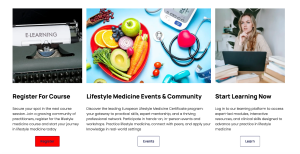
It really delivered a modern experience for us educationally, technologically.
Dr. Ioan HanesJoining Automattic for Agencies
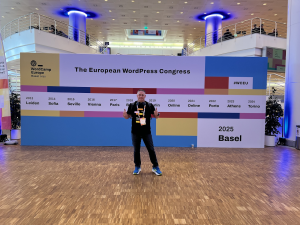
Bela attended his first WordCamp Europe in 2024 and decided to join Automattic for Agencies.
For him, the decision was straightforward.
He had been running client sites across different hosting providers for years. Consolidating everything on WordPress.com, under the program built by the people who own the technology, made sense for the long term.
It’s best to stick with the founders of WordPress. In the long run, that gives you confidence.
Bela Grundmann, HealthPressHe is now an official Automattic partner. Every client site HealthPress manages runs on WordPress.com.
What comes next
Godfrey is launching a course in June to teach other clinicians how to set up their own lifestyle medicine programs.
Ioan’s Brussels event, 10-12 September 2026, will run on the platform for the first time, combining the in-person experience with digital access for those who can’t attend.
For Bela, the vision is 500 lifestyle medicine professionals on the platform.
One million people reached through them. A solo agency, growing without limits, because the infrastructure scales with it.
-
Murphy Levesque Co-Founded an Animal Rescue at 11. Her WordPress.com Site Helped Save Over 100 Animals.
15 aprile, di WordPress.com Staff — Customer Stories, success stories, WordPress.com Murphy Levesque is a high school senior in Connecticut. She co-founded Hidden Gem Animal Rescue in 2020, when she was 11 years old.
It started with a one-eyed cat named One-Eye at the barn where Murphy took horseback riding lessons. One-Eye was two years old, missing an eye, and on her third litter of kittens.
Murphy and her riding trainer Logan trapped the kittens, got them veterinary care, and found them all homes.
That was the spark. They kept going.
Today, Hidden Gem Animal Rescue is a registered 501(c)3 nonprofit operating across Connecticut and the Northeast, rescuing dogs and cats, running on a network of foster families, and taking cases from as far as Texas and North Carolina.
Since Murphy started working with WordPress.com around three years ago, the rescue has helped over 100 animals, roughly doubling their previous pace.
What the website changed
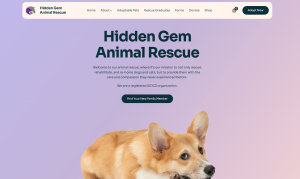
Before the website, Hidden Gem had a presence on Instagram and Facebook, but no central place to send people. Her website, developed by the Automattic Special Projects team and hosted on WordPress.com changed that.
I honestly don’t know what my website would look like without you guys. It just looks so incredible.
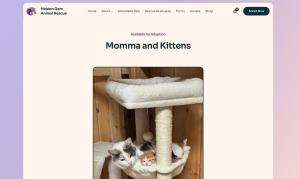
Anyone who sees a post and wants to learn more can follow the link, understand how the rescue works, and take action right there. Whether that means applying to foster, filling out an adoption application, or making a donation.
It really just became easier for people. And it’s always better when it’s easier for people because they’re more likely to actually take their time to look at it.
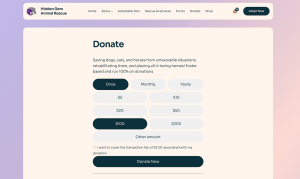
Donations in particular became more seamless. The website added a proper donation platform alongside Venmo, giving supporters more ways to give and making the rescue look more like the legitimate organization it had become.
The website makes it look more professional. And people can look at all the cute animals and think, oh, this is something I want to donate to.
It’s been really seamless. I’ve really been able to figure it out and make the updates I want to make.
Murphy also used Blaze Ads to run advertisements for their available animals, bringing in a new wave of traffic and visibility for the rescue.
What’s next for Hidden Gem Animal Rescue
Murphy is already thinking about what comes next for the rescue.
The goal is to find a physical location, keep building the rescue’s profile and systems, and make the whole experience easier for everyone involved — volunteers, fosters, and adopters.

The website will be central to all of it.
It gains traction and lets people interact with us. It really helps us build our image.
Your story deserves a home, too
Murphy runs a nonprofit, manages social media, and updates a website while finishing high school.
WordPress.com gave her a professional platform she could grow into, with the tools to manage it as the project evolved.
Whether you’re just getting started or ready to take things to the next level, WordPress.com gives you everything you need to build a site that works as hard as you do.
-
What We Learned (and Loved) at WordCamp Asia 2026 in Mumbai
14 aprile, di Ronnie Burt — News WordCamp Asia 2026 just wrapped in Mumbai, and it was one of the largest WordPress events ever. WordPress users, developers, and creators gathered at the Jio World Convention Centre for three days of building and learning together.
Before we get into the highlights, a massive thank you to the organizers, volunteers, and speakers who made this happen. Attendees came from right here in Mumbai, across India, and around the globe.
Contributor Day kicked things off
If you’ve never heard of Contributor Day, it’s exactly what it sounds like — people sit down together and contribute to the open-source WordPress project. Code, documentation, translations, community planning, and more.
The magic isn’t just the work that gets done. It’s the connections. New contributors sat alongside people who’ve worked on WordPress core for over a decade. Ideas got shared. Friendships started and renewed. This is where WordPress’s “extended family” energy comes from. Find the full official recap post here.
Sessions worth your time
After contributor day, we held two full days of talks that covered everything from enterprise scaling to cross-border payments. You can watch every session on YouTube. Here are a few we attended and want to spotlight.
Education initiatives in the WordPress ecosystem
A dedicated panel covered WordPress Education — the growing effort to bring WordPress directly to students through campus events, student clubs, and a credits program that partners with universities to integrate WordPress into their curriculum. Real-world, hands-on open source experience for the next generation of web creators.
The Speed Build Challenge
Moderated by our own Jamie Marsland, this one packed the room. Ajay Maurya and Craig Gomes went head-to-head — one using AI, one going fully old-school — with 30 minutes to rebuild a complete site using only the Full Site Editor. No page builders, no custom code. There was no clear winner, which made it even more fun.
Danny Sullivan at the Google booth
Danny Sullivan is a Google Search Director and one of the most well-known voices in SEO. He was right there live at the Google booth, giving 1:1 advice to WordPress folks in person. While this wasn’t an official session on the schedule, it is the kind of thing that only happens at a WordCamp.
We heard him share that the same long-standing principles of quality content for good SEO still apply in today’s AI world. But it’s even more important now to have a strong point of view, a distinct voice, or a unique position. Without that, you’re just creating commodity content, which is less likely to be cited or used by LLMs. Content remains king.
Mary Hubbard’s magic wand
Mary Hubbard, Executive Director of WordPress, was asked what one surprising thing she’d change about WordPress if she had a magic wand. Her answer was to improve the WordPress.org plugin directory by treating it as a product and less like infrastructure. A lot of heads nodded at that one, and we look forward to helping make that vision a reality.
AI was everywhere
No surprise, but AI came up often throughout the conference. Including a talk from Nirav Mehta, a Mumbai-based entrepreneur. His Lost & Found in AI Wonderland session was a walkthrough of what actually worked (and what didn’t) when his team tried to apply AI across development, marketing, and operations.
Nirav reminded us that like a hammer, AI is only a tool. When you hold a hammer, everything begins to look like a nail. AI may not always be the right tool for the job. In a time full of AI excitement, that kind of honesty was refreshing.
What WordPress.com brought to Mumbai
The WordPress.com team showed up strong with a few things to share, and the conversations at our booth didn’t stop all week.
Plugins and themes on every paid plan. We made sure everyone knew: you can now install plugins and themes on all WordPress.com paid plans. Developers and agencies who build on WordPress every day loved hearing about the flexibility this means for pricing and features on our hosting platform.
A new WordPress agent on Telegram. We showed off a brand new Open-Claw-inspired WordPress agent you can chat with directly from Telegram — with WhatsApp and more platforms coming soon. The idea of managing every aspect of your WordPress site through a conversation on your phone sparked a lot of “wait, what if…” moments at the booth. More on this soon!
Your feedback is heard. Beyond the demos, we spent a lot of time talking to users, agencies, and developers who gave us direct, honest feedback about what’s working and what isn’t on WordPress.com. We’re already bringing all that learning into our roadmap and future plans. A huge thank you to everyone we chatted with.
The WordPress community is as strong as ever
It is clear after a week in Mumbai that this community is growing, and the momentum is real.
The hallway conversations, the contributor sprints, the after-parties, the people who traveled halfway around the world to be in the same room — that energy isn’t slowing down.
If you’ve never been to a WordCamp, make this your year. And if a full conference feels like a big step, start with a local meetup. Find one near you at events.wordpress.org.
Now with four flagship WordCamps a year:
- WordCamp Europe — Kraków, Poland, June 4–6, 2026.
- WordCamp US — Phoenix, Arizona, August 16–19, 2026.
- WordCamp Asia 2027 — Penang, Malaysia, April 9–11, 2027.
- WordCamp India (TBD) — A brand new flagship event joining the lineup in 2027.
We can’t wait to see you there.
And with that, namaste, Mumbai!
-
How to Choose Headless WordPress Hosting: A 2026 Checklist
14 aprile, di WordPress.com Staff — Tips and Tutorials, Managed Hosting, WordPress.com Headless WordPress allows you to use an alternative stack on the frontend — but it usually requires hosting for two separate environments instead of one.
Most projects need managed WordPress hosting for the backend and dedicated frontend hosting that matches how your app renders.
It’s important to understand the tradeoffs of choosing headless WordPress as it can add more complexity to the equation.
Here’s how to make both decisions without overcomplicating it:
Step 1: Confirm you need headless WordPress
Headless makes sense when you need frontend flexibility, performance, or multisystem integration that goes beyond what a traditional WordPress setup supports.
In a traditional setup, the frontend and backend live on the same platform. In a headless setup, they’re separate — connected only through an API.
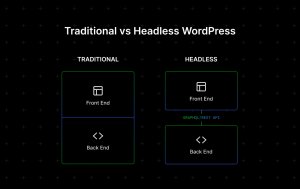
Headless is a more complex system, so it’s worth being certain your project actually needs it.
Go headless when:
- You’re building with a JavaScript framework rather than WordPress themes.
- WordPress is powering multiple surfaces: a website and a mobile app, for example.
- You need to connect WordPress to other platforms or external SaaS tools.
If none of that applies, a well-optimized traditional WordPress setup is usually faster to ship, less expensive to run, and easier to maintain.
Step 2: Decide how your frontend will render
Your rendering strategy determines which frontend host you need, so define it before you start comparing plans. Rendering is simply how your frontend turns WordPress content into the pages visitors see.
Here are the key options to choose from:
- Static (SSG) works best for sites where content doesn’t change frequently. When you publish your site, pages are built once at deploy time and served as static HTML from a CDN. It’s the fastest and cheapest option and works well for marketing sites, blogs, landing pages, and documentation where a short delay after publishing is acceptable.
- Server-side rendering (SSR) is for when you need to personalize pages per user or reflect real-time data. Pages render on each request, which requires Node.js infrastructure and is more expensive to run.
- Hybrid (ISR) sits in between. Pages are static, but you can update them on a schedule or when content changes, without a full rebuild. It works well for sites that publish frequently but don’t need true real-time rendering.
The simplest way to choose: If every visitor sees the same page, SSG or ISR is almost always a good choice. If the page needs to vary per user, you need SSR.
Step 3: Pick a host for the WordPress backend
Choose a backend host that can manage API traffic, editor activity, and traffic spikes reliably. You also want a host that scales when needed and ensures your WordPress environment is secure and up to date.
Since your frontend depends on WordPress to deliver content, backend performance directly affects what visitors experience.
In server-rendered and hybrid setups, that means handling continuous API requests. Even for static builds, the backend needs to perform well at build time and whenever content updates trigger a rebuild.
Here’s what matters most:
- Performance: Fast API response without relying on third-party caching plug-ins.
- Scalability: Traffic spikes shouldn’t require emergency upgrades or come with surprise charges.
- Security: The host should provide SSL, firewall protection, and backups.
- Developer tools: These include SSH/SFTP, WP-CLI, and staging environments.
Selecting the right provider
WordPress.com is the right backend host for most headless projects. The Business and Commerce plans come with everything a headless build needs from the beginning: built-in object and edge caching, automatic updates and security patches, and a CDN for media and static assets.
On the developer side, you get SSH access, WP-CLI, and staging environments, plus predictable pricing with unmetered bandwidth so traffic spikes don’t come with unexpected costs.
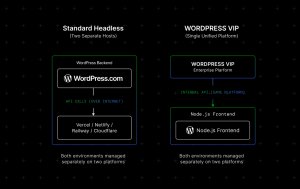
If you need the WordPress backend and a Node-based frontend managed on a single platform, WordPress VIP is worth exploring. It’s built for enterprise-scale sites with millions of monthly visitors and comes with dedicated support and SLAs. The prices for this platform match that level of scale, so if budget is a consideration, WordPress.com with a separate frontend host will effectively cover most projects.
Step 4: Find a host for the frontend
From here, match your frontend host to your rendering strategy. Here’s how:
- Static sites work best with CDN-based hosting that serves prebuilt HTML.
- Server-rendered apps rely on Node-compatible hosting to render pages on request. Verify that this supports your framework and Node version.
- Hybrid setups require a Node runtime with revalidation support so pages can refresh on publish without a full rebuild. Factors such as build minutes, bandwidth, or requests typically determine the cost, so check the pricing model before committing.
Beyond rendering, check that the host supports git-based deploys compatible with your branching workflow and preview URLs for pull requests and draft reviews.
You should also confirm there is a clear publishing flow so you know how a WordPress content update reaches the live frontend, whether that’s a full rebuild, a webhook, or revalidation.
How to choose your headless WordPress hosting
The bottom line: When choosing headless WordPress hosting, the backend and frontend decisions are separate but connected.
Here’s what the right setup looks like for most projects:
- Use WordPress.com for a managed, scalable WordPress backend that handles API traffic without requiring you to manage the infrastructure.
- Choose your frontend host based on your rendering strategy (SSG, SSR, or ISR).
- Opt for WordPress VIP when you need both environments managed together on a single enterprise platform.
WordPress.com gives you a managed, secure, and scalable WordPress environment so your team can focus on building the frontend instead of maintaining servers.


 RSS 2.0