 AgoraVox Italia
Start a WordPress blog or create a free website in seconds. Choose from over 200 free, customizable themes. Free support from awesome humans.
http://www.imhoffpress.worpress.com
Articoli
-
WordPress.com Is Now Available in Stripe Projects
10 giugno, di Ramy Nasr — Admin Bar, Development, News, CLI, integrations, Stripe, WordPress developers
WordPress.com is now available as a provider on Stripe Projects.
Starting today, developers and their AI agents can provision a complete WordPress.com site, register a domain name, and activate a plan directly from the CLI. All this without opening a browser, logging in to a dashboard, or switching tools.
So if you’re already working in Stripe Projects, WordPress.com is now one command away. It’s one more step toward making WordPress.com easier to build with inside modern developer workflows.
Build and launch without leaving the terminal
For developers building with AI agents, CLI tools, and repeatable workflows, setup friction matters.
Now you can link your Stripe account to a WordPress.com account (or create a new one on the spot), then spin up a site, grab a domain name, and choose a plan — all from your terminal.
The full flow happens programmatically, which means it fits cleanly into the way developers already work: automated, repeatable, no UI required.
Joining Stripe Projects is a natural fit for WordPress.com. Developers already use Stripe to power payments, now they can spin up a full WordPress.com site, register a domain name, and choose a plan in the same workflow, without ever switching context. We built this so developers can move faster and spend less time on setup.
— Ian Stewart, Artistic Director and WordPress.com Lead
How the WordPress.com provider works
Adding WordPress.com to Stripe Projects means a production-ready WordPress site, domain, and plan can be provisioned without jumping between dashboards.
Once you have a Stripe account, Stripe Projects CLI installed and your project set up, use the commands below from your terminal.
To create a WordPress.com site:
stripe projects add wordpress.com/siteYou’ll be presented with site plans, including a free option. Once you pick a plan, the site is created and billed to the payment method you already have on file with Stripe.
<script src='https://v0.wordpress.com/js/next/videopress-iframe.js?m=1770107250'></script>To register a domain:
stripe projects add wordpress.com/domainEnter a query or the domain name you want. You’ll see 15 domain name suggestions to choose from, and once you select one, it’s automatically registered using your Stripe payment method.
If you don’t have a WordPress.com account, one will be created and linked to your Stripe account as part of the flow.
What WordPress.com brings to the stack
WordPress.com powers millions of production sites, including storefronts, business properties, and merchant sites running at scale. It comes with managed hosting, automatic updates, security, and a full domain marketplace built in.
For developers who want a production-ready site without the infrastructure overhead, it fits without adding complexity to the stack.
And now it’s available without the signup flow.
WordPress.com is live on Stripe Projects today. Install the Projects CLI at projects.dev or explore WordPress.com’s developer tools at developer.wordpress.com to see how managed WordPress fits into modern app and agent workflows.
-
WordCamp Europe 2026: Worth the Wait
9 giugno, di Molly Lane — News, Automattic, Community, WordCamp, WordCamp Europe I’ve been building sites on WordPress since 2010. These days I work in marketing at WordPress.com. And somehow, until Kraków, I’d never been to a WordCamp.
WordCamp Europe 2026 drew 2,458 attendees from 81 countries to the ICE Kraków Congress Centre — a stunning modern venue sitting at the edge of one of Europe’s most historically rich cities. Nearly a quarter of us were first-timers. I was in good company.
The city told the story
What struck me immediately about Kraków: it’s the kind of place where history is visible, tangible, and layered. Contrast that with the ICE Congress Centre — glass, light, sharp angles, forward momentum — and something clicks.
This is WordPress.
A platform that started as a blogging tool in 2003 and now powers 43% of the internet. Ancient roots in the online publishing era, yet somehow relentlessly modern. Still building. That metaphor was immediately obvious.

Before the sessions: The people, the pins, the Wapuus
I arrived on Contributor Day, the pre-conference session where the WordPress community gathers to contribute — code, documentation, community planning. Meanwhile, members of the WordPress.com team were in a nearby hotel room unpacking boxes of custom pins, matching t-shirts, and carefully curated swag to hand out at our booth. That’s the texture of this community: people who show up early, do the behind-the-scenes work, and genuinely want to be here, together.
Across the floor, our team was deep in demo prep — walking through the latest features, pressure-testing the flow, making sure every talking point was sharp before the doors opened. The pride our team takes in their work, and in the people using our products, spoke for itself.
The Wapuus were everywhere. If you’re new to WordCamp and new to Wapuu — the round, cheerful “official unofficial” WordPress mascot that each WordCamp reimagines in local style — I hope you were as delighted to meet the Kraków edition as I was.

I started with toast
My first session was called How to Make Toast, led by Stacy L. Carlson.
I sat next to Uffe Christiansen, a partner in the Automattic for Agencies program, and we worked through the exercise together. The premise: map out how to make toast. Every step. Don’t skip anything.
Sounds simple. It isn’t. Groups within the session came up with wildly different process maps — anywhere from 3 steps to 20. Use pre-sliced bread or cut from a whole loaf? Plug in the toaster first or load the bread? How dark is dark enough — and who decides?
That’s the exercise. Not toast. Assumptions. The steps we skip because we think they’re obvious. The judgment calls we make automatically that someone else makes completely differently.
If you can’t map your own process, you can’t hand it off — to a team member, to a tool, to an AI. Toast first. Everything else second.
The search conversation continues IRL
I lead a content team that has spent the last year working to meet customers where they are as their search behavior shifts — from SEO to AIO and beyond. So I was grateful to see this topic represented across nearly every session block. Here’s what I heard, across multiple sessions, from multiple speakers:
The old rules still hold — they just have higher stakes. Great content, real perspective, genuine expertise. These have always mattered. Now they’re table stakes for being cited at all. The tools change; the fundamentals don’t.
Brand is the new backlink. The brands winning in AI-driven search have something in common: consistent opinions, real customer data, a distinct voice, presence across multiple platforms, and the discipline to show up the same way everywhere. Simple in theory. Hard in practice. When you get it right, it starts to reinforce itself.
We’re not chasing clicks anymore. We’re chasing citations. Multiple 2026 studies on AI citation patterns found that 85% of brand mentions in AI responses come from third-party pages — not your own domain. Content strategies built entirely around Google rank are already working from an incomplete map.
AI traffic converts at a higher rate — because AI pre-qualified your brand. If an LLM cites you, the person clicking already trusts you. That changes the math on what “less traffic” actually means.
It’s not “is this good.” It’s “is this different.” Commodity content — content that sounds like everyone else’s content — doesn’t get cited. Original research, real data, genuine point of view: those are citation magnets.
AI won’t save your marketing. That was the title of one session. The tools change. The fundamentals don’t. Know your customers, read your report tickets and your reviews. Solve those problems, and write about it.
And underneath all of it, a direction that felt significant: SEO is no longer an isolated discipline. It’s merging with AIO, brand strategy, PR, and content — a more holistic practice where all the signals work together more than ever before.
Accessibility isn’t a feature. It’s core to the conference.
One thing I didn’t expect: how intentional this community is about inclusion — not as a talking point, but as an operational standard.
Free childcare was available onsite. Sessions addressed neurodivergence. One talk made the case that optimizing for accessibility isn’t just the right thing to do — it’s better for the business. Industry research backs it up — 75% of organizations report accessibility directly contributes to improved revenue, and 62% of business leaders say customers have abandoned transactions because of inaccessible experiences. The open web is most valuable when it’s accessible to everyone. Customers benefit. Businesses benefit. It’s not charity; it’s smart design.
Some things don’t change
I didn’t expect a conference about the future of the web to keep coming back to the same old truth. But it did. No shortcuts. Hard work, authenticity, consistency — they cut through the noise now the same way they always have.
The technology changes. AIO, SEO, vibe coding, AI agents — the landscape looks nothing like it did five years ago and will look nothing like this in five more. But the core principles haven’t moved. Know your customer. Serve their needs in a way only you can. Be consistent. Be real. Do the work.
That’s not just advice for your content strategy. It’s how this community operates. It’s why people fly to Kraków from 81 countries to sit in workshops about toast, debate the future of search, and unpack boxes of pins in hotel rooms before the doors open.
If you’ve never been to a WordCamp, go. If not just for the sessions, then for the reminder that the fundamentals still hold, that the people building the open web are worth knowing, and that there is no algorithm, no AI, no shortcut that replaces doing something genuinely worth your audience’s time.
WordPress.com has been part of this community since the beginning, built on the same principles the whole conference kept coming back to. If you’re ready to build something on the open web, we’d love to have you.
First WordCamp in the books. Find one near you — or mark your calendar for a flagship:
- WordCamp US — Phoenix, Arizona, August 16–19, 2026
- WordCamp Asia 2027 — Penang, Malaysia, April 9–11, 2027
- WordCamp Europe 2027 — Málaga, Spain, May 27–29, 2027
- WordCamp India — TBD, 2027
And please, keep the Wapuus coming.
-
Click, Comment, Done: A Better Client Feedback Loop with Studio Code
8 giugno, di Alexa Peduzzi — Development, Automattic for Agencies, WordPress Studio I had a great talk with an agency partner, Marco from Arsnova, at the WordPress.com booth at WordCamp Europe a few days ago. Halfway through the conversation, I realized the feature I reach for almost every day would erase one of the most tedious parts of an agency’s job: chasing down client edits one screenshot at a time.
Studio Code is an agentic WordPress expert that lives in your terminal, helping you build sites, plugins, and themes locally on your computer. It’s part of the WordPress Studio suite of tools. Just describe what you want in plain language, and it gets to work. Think of it as a senior WordPress developer helping you build, with deep knowledge of WordPress baked in.
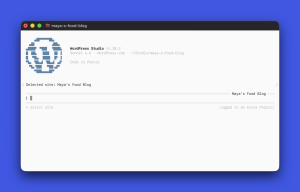
One of my favorite features built into Studio Code is a powerful little slash command called
/annotate.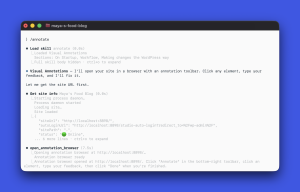
I told so many people about this feature at the booth, over Slack, and in hallway conversations with colleagues because it helps me solve a problem that I always have with similar coding agents: the classic screenshot-arrow-request feedback loop.
Without
/annotate:- My coding agent creates something.
- I don’t like a few elements, so I take screenshots of the things I don’t like and manually annotate it with arrows.
- I upload the screenshots back to the agent, explaining the changes I want.
- Repeat forever until the coding agent gets it right.
But with
/annotate:- Studio Code creates something.
- I want to make some changes, so I type /annotate.
- It launches a browser window where I can click on specific elements to give feedback, lump the feedback together, and send it all back to Studio Code at the same time.
- Studio Code makes the specific changes I requested all in one go.
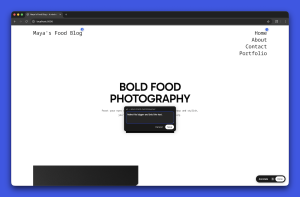
Remember Marco, the agency partner I mentioned at the beginning? As I was demonstrating this feature in Studio Code for Marco, a colleague (Davi!) mentioned that this would be a time-saver and an excellent user experience to run
/annotatewhile on a call with clients.Picture this: you’re on a call with a client, sharing your screen, walking through the site you built them. They point out changes as you talk. You drop annotations, as many as you want, as specific as you want, and Studio Code makes every edit when you’re done.
No more endless feedback loops. One
/annotatesession, and all of their changes are live on your local site. Then you can push the updated version to your client’s live WordPress.com-hosted site in just a few clicks.Studio Code is currently in beta, and you can try it by downloading Studio CLI (either from the desktop app or directly from your terminal) and running
studio code. Then simply select or create a local site and run/annotateto try this feature out for yourself.As a reminder, tokens are unlimited while Studio Code is in beta — build, iterate, and give us feedback on GitHub.
-
WordPress.com Changelog: WordPress 7.0 and Ways to Repurpose Your Written Content
6 giugno, di WordPress.com Staff — Changelog, Podcast, Video, WordPress Core, WordPress.com Reader May 22–June 4, 2026
Welcome back to the WordPress.com changelog!
We have lots to update you on, including information about a new core version running on every WordPress.com site, how you can repurpose your written blog content in audio and visual forms, and so much more.
Core
WordPress 7.0 is here
WordPress 7.0 (“Armstrong”) shipped on May 20, and your WordPress.com site has been automatically updated.
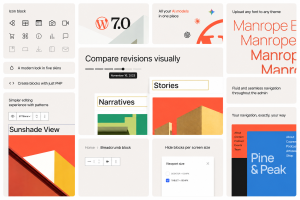
The pieces you’ll experience right away:
- See what changed before you hit publish: Your post revisions now have visual markers to help you understand changes in a more intuitive way.
- Design your mobile menu like you design the rest of your site: Navigation overlays give the mobile experience its own dedicated editing canvas.
- Show different things on phone, tablet, and desktop: Responsive block visibility lets you pick which blocks appear on which device without writing CSS.
- More design pieces out of the box: New Breadcrumbs and Icon blocks, plus finer block-level controls for when you want a specific change.
- One place to manage your fonts: To use across every theme on your site.
On WordPress.com, this release ships with our AI features already in place to assist you in the editor, with your favorite AI agent, and beyond, plus real-time collaboration on select plans, so multiple people can write in the same post at once.
Reader
One place to read Bluesky, Mastodon, and blogs
Keeping up with your audience shouldn’t mean tab-hopping between different apps. Connect your Bluesky, Mastodon, or Fediverse accounts to the WordPress.com Reader and you can read those timelines next to the WordPress.com blogs you already follow — and like, repost, quote, and reply — in the Social Feeds section.
You can write to those followers from the same place. Start with a short social post, and if you need more room, expand it into a full blog post without starting over.
One spot to read what matters, react to it, and publish your own thoughts.
Writing
When you’re in the flow, the editor gets out of your way
Sometimes you just want to write. Not pick a block, not configure a layout, not browse a sidebar — just write. Write is exactly that: one page, a blinking cursor, simple formatting, and nothing else.
It’s in beta on every WordPress.com plan, including Free. Open Write, pick your site, and start typing. What you write is a real WordPress post — it lives alongside everything else, works with your theme, and you can open it in the full block editor whenever you need the rest of the toolkit.
<script src='https://v0.wordpress.com/js/next/videopress-iframe.js?m=1770107250'></script>Reach the people who’d rather listen than read
Whether your audience is commuting, multitasking, or simply prefers to learn through audio, your content can meet them there.
Posts to Podcast turns a post you’ve already written into a two-host conversation episode, saves it to your Media Library, and queues a draft post with the audio and transcript so you can publish in a couple of clicks. One post, two ways for people to find you.
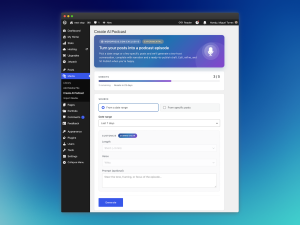
Find it in your dashboard under Media → Create AI Podcast. Available on every WordPress.com site.
P.S. If you want to host the podcast on WordPress.com instead, you can also set up podcasting with Jetpack Podcast and publish episodes from your site.
Spin a post into a short social-ready video (experimental preview)
Short-form video (like on Instagram and TikTok) is popular and engaging, but turning a blog post into one has meant needing a second tool, a video editor, or someone you pay.
Feature Clips generates a short, vertical video based on your post content directly from the editor sidebar. Pick a suggestion drawn from your post, or write your own prompt to steer the look.
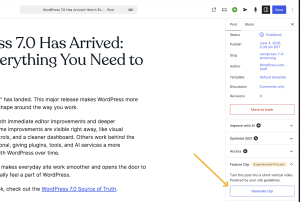
Your clip lands in your Media Library, ready to share to Instagram via Jetpack Social or download as an MP4 for TikTok and YouTube Shorts. It generates short instrumental clips meant to tease your content.
Available now on WordPress.com plans that support video uploads — Premium and up. You get ten generations per site per day, with a thumbs up / thumbs down feedback tool on each clip so you can easily send your thoughts back to our team.
Settings and plans
Shape your URLs (and four more settings) on every paid plan
The structure of your URLs matters — for SEO, for sharing, for how users understand your site at a glance. That setting (called Permalinks) used to be locked behind higher plans. Now, every paid plugin-enabled WordPress.com plan (Personal, Premium, Business, and Commerce) can change permalink structure directly.
Fixes and improvements
We also shipped some reliability and polish updates across the WordPress.com experience:
- The Reader sidebar now shows your site’s custom domain instead of its free subdomain.
- Receipt amount, type, and date now show inline on your Billing History page at narrower widths.
-
WordPress 7.0 Has Arrived: Here’s Everything You Need to Know
4 giugno, di Philip Adams — Admin Bar, News WordPress 7.0 “Armstrong” has landed. This major release makes WordPress more connected and easier to shape around the way you work.
WordPress 7.0 includes both immediate editor improvements and deeper foundational changes. Some improvements are visible right away, like visual revisions, responsive controls, and a cleaner dashboard. Others work behind the scenes are more foundational, giving plugins, tools, and AI services a more consistent way to work with WordPress over time.
The result: A release that makes everyday site work smoother and opens the door to optional AI tools that actually feel a part of WordPress.
For a deeper technical look, check out the WordPress 7.0 Source of Truth.
What’s new in WordPress 7.0
WordPress 7.0 brings updates across AI, editing, design, performance, accessibility, and developer tooling. These changes affect how you build, update, and manage your sites.
WordPress 7.0 updates include:
- AI foundations: The AI Client, Connectors API, and Connectors screen give WordPress a more consistent way to connect with AI providers and external services.
- Editing and admin improvements: Visual revisions, a refreshed dashboard, smoother transitions, Command Palette access, and broader font management make everyday site work clearer.
- Flexible design controls: Custom navigation overlays, responsive block visibility, and pattern editing make it easier to shape pages without adding workarounds.
- New and improved blocks: Breadcrumbs, Icons, gallery lightbox improvements, Heading block updates, and block-level styling controls bring more practical tools into the editor.
- Performance, accessibility, and developer updates: Under-the-hood improvements support faster loading, better editor stability, stronger accessibility, and more consistent foundations for plugins and custom builds.
Building a foundation for AI workflows
WordPress 7.0 introduces a new shared AI layer designed to make AI tools feel more native across WordPress.
Instead of every plugin building its own separate AI setup, WordPress now includes a common system for connecting tools and services. Plugins can communicate with AI models such as Claude, ChatGPT, and Gemini through the new AI Client. The Connectors screen provides site owners with a single place to manage those integrations.
Note: These AI features are optional and need to be enabled by the site owner. Nothing is automatically shared with AI services when WordPress 7.0 is installed.
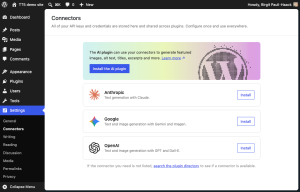
The optional AI plugin already brings features like title and excerpt generation, image generation and editing, and suggested alt text directly into the editor. As more plugins build on the same system, AI tools across WordPress become easier to use, manage, and extend.
On WordPress.com, this builds on AI tools already available across the platform, including the AI Assistant, Claude connections, and WordPress Studio workflows.
Want to understand how this all fits together? Take a closer look at how WordPress 7.0 is building the foundation for AI-powered sites.
Creative freedom inside the editor
Visual revisions make it easier to understand changes in a post or page. Instead of scanning a dense comparison view, you can review revision history with visual markers, navigate versions, and restore the one you want with greater confidence.
The dashboard also feels more modern and cohesive. WordPress 7.0 introduces a new default admin color scheme, smoother screen transitions, and a Command Palette shortcut in the top admin bar for faster access to tools.
Font management is also easier. The Font Library now works across block, hybrid, and classic themes, giving more sites one place to browse, install, upload, and manage fonts.
A new canvas for every screen
Designing for mobile used to mean making compromises. WordPress 7.0 changes that with a dedicated canvas for navigation overlays, responsive block visibility, and simpler pattern editing.
Navigation overlays now have their own editing canvas, allowing mobile menus to go beyond a simple list of links. You can start with a template or build your own overlay with blocks, columns, typography, and custom close buttons.
Responsive block visibility lets you choose which blocks appear on desktop, tablet, or mobile. That makes it easier to create cleaner layouts for different devices while keeping alternate versions available as you iterate.
Patterns are also simpler to update. A pattern can behave like a single block, so you can swap text and images or adjust styles without digging through every nested block. Advanced controls are still available when you need them.
<script src='https://v0.wordpress.com/js/next/videopress-iframe.js?m=1770107250'></script>Flexible design tools for richer layouts
WordPress 7.0 brings more practical control into the editor, making it easier to shape pages without relying on extra tools for every small design need.
The new Breadcrumbs block helps visitors understand where they are on a site, while the Icon block adds simple visual cues from a built-in library. Gallery lightbox improvements make image browsing smoother, and Heading block updates make it easier to work with page structure.
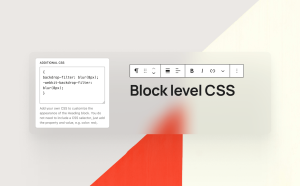
The same idea carries through to layout and styling. Responsive block visibility lets you choose which content appears on different screen sizes, while block-level CSS gives more control over individual blocks when a page needs a custom touch.
Taken together, these updates make WordPress feel more flexible in the places site owners work most: building pages, refining layouts, and helping visitors move through a site more easily.
A stronger platform for WordPress development
WordPress 7.0 provides developers with a more consistent foundation for building plugins, blocks, patterns, and site-editing experiences.
The release includes expanded APIs, PHP-only block registration, a more extensible Site Editor, and routing improvements that make it easier for plugins to build custom Site Editor pages.
These updates will not be visible to every site owner on day one, but they matter because they shape what WordPress developers can build next. Better foundations mean better tools, workflows, and site experiences over time.
Built by the WordPress community
WordPress 7.0 is a reminder of how open source software keeps evolving through shared contribution. The release reflects work from more than 875 contributors around the world. That community work is part of what makes WordPress different.
WordPress 7.0: Fully Managed on WordPress.com
WordPress.com is here to bring the best of every new WordPress release to you fast and without the setup.
WordPress 7.0 is no different. The new AI foundations build on tools already live across the platform, including the AI Assistant, Claude connections, and Studio workflows.
And on select plans, real-time collaboration is already available, letting teams work on the same site simultaneously, before it’s widely available elsewhere.
All of it backed by the security, performance, and support that comes with a fully managed platform.
You bring the vision. We handle everything else.


 RSS 2.0